Vecna Robotics services keep fleet readiness tied to acceptance evidence
Service work for AGV and AMR fleets fails when maintenance, spares and escalation are divorced from the same rate and interface assumptions used in design. Vecna Robotics frames lifecycle support as a continuation of FAT and SAT evidence, not a separate brochure track.
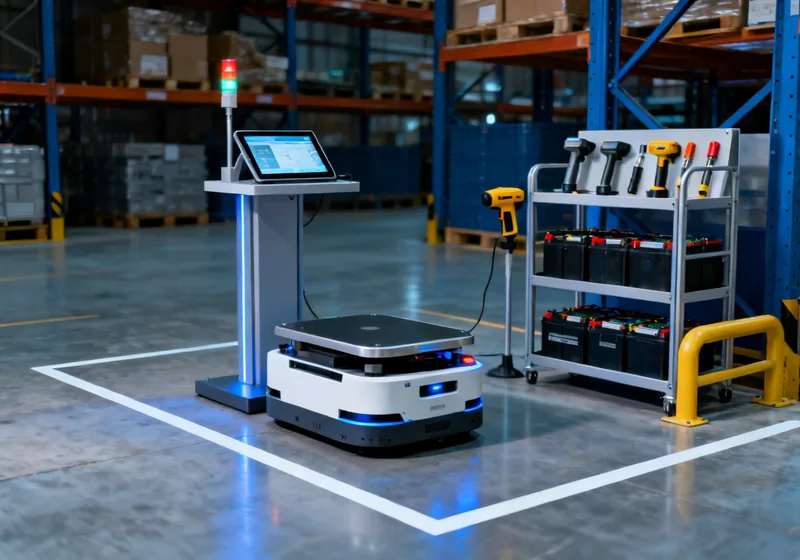
Support regions follow project scope, not a global blanket claim
Regional presence is useful when response paths, remote access rules and on-site skill boundaries are written into the same operating concept used for throughput. Planning figures such as multi-region coverage are evaluation aids and must be confirmed for each installed fleet.

- North America project desks — commissioning windows aligned to brownfield cutover and overnight maintenance slots.
- Europe integration partners — functional-safety documentation paths for ISO 3691-4:2020 and ISO 13849-1:2015 references when in scope.
- Asia manufacturing logistics — takt-linked line feeding with PLC handshake owners named before go-live.
- Remote initial-response — alarm triage and configuration review when network policy allows controlled access.
Maintenance intervals belong next to duty cycle and peak windows
A fleet that runs a short promotional peak five nights a week ages differently from a steady manufacturing milk-run. Vecna Robotics asks teams to schedule inspections against actual duty cycle, aisle contamination, battery chemistry and scanner field integrity rather than a generic calendar alone.
- Week 0
Commission baseline
Capture floor quality, wireless maps, scanner field checks, charging behavior and interface version stamps used during SAT.
- Month 1–3
Stabilization reviews
Compare mean time to repair in minutes, blocked-route frequency, buffer occupancy and system availability percent against the design rate assumptions used in SAT.
- Quarterly
Safety and traffic audit
Revalidate restricted zones, pedestrian crossings, traffic priority tables and manual intervention procedures.
- Annual
Capacity re-baseline
Update SKU velocity, peak duration and expansion destinations so spare parts and charging capacity stay aligned.
Spares planning protects recovery, not just shelf presence
Criticality depends on whether a failed unit removes a unique path, a shared charger or a control handshake. The matrix below is a planning template; quantities and lead times must be set by the installed configuration and contractual response targets.
| Item class | Why it is critical | Planning signal | Evidence to keep |
|---|---|---|---|
| Drive / caster modules | Removes travel capacity on constrained routes | Duty cycle hours and floor condition | Failure log with aisle location |
| Safety laser scanners | Blocks release into shared pedestrian space | Contamination and impact events | Field check records |
| Battery / charger sets | Creates artificial peak starvation | Charge window vs peak window overlap | State-of-charge traces |
| Compute / radio kits | Breaks fleet management system connectivity | Network policy and failover tests | Alarm and reconnect logs |
| Load adapters | Stops a specific pallet or tote family | SKU mix changes after go-live | Adapter-to-SKU map |
Describe the installed boundary before asking for a service plan
Share robot count, routes that cannot be bypassed, host interface owners, allowed remote access, spare-parts location and the recovery time that keeps peak rate honest. State target system availability (for example 95% or 98% end-to-end) with the measurement window. Vague uptime language without a boundary is insufficient for a Vecna Robotics lifecycle proposal.
Request a service readiness review