Design Rate
Moves or order lines per hour qualified by SKU velocity, load mix, replenishment demand, peak duration and buffer occupancy.
Rate inputs →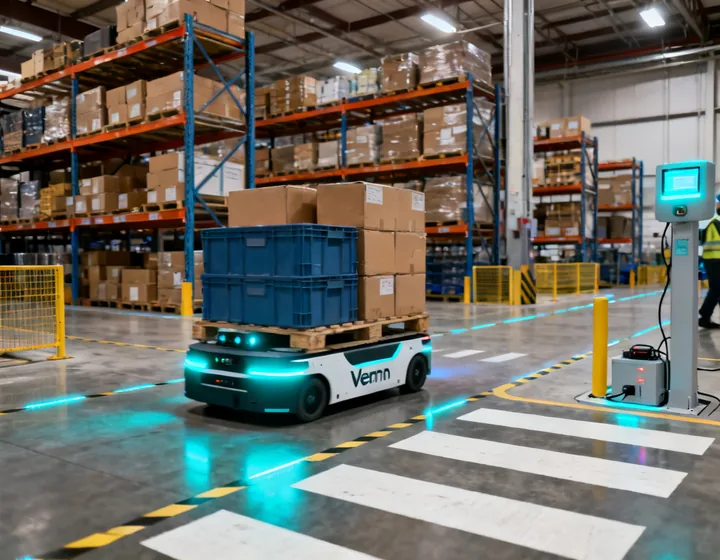
State load units, route geometry, peak windows, control handshakes and exception recovery before comparing fleet size. Clearer inputs shorten evaluation and protect live cutover.
Each gate links a project statement to a stated operating condition and a reviewable deliverable for Vecna Robotics mobile-robot programs.
Moves or order lines per hour qualified by SKU velocity, load mix, replenishment demand, peak duration and buffer occupancy.
Rate inputs →Robot behaviors, safety laser scanner fields, fleet rules and interface messages checked against an agreed test or emulation profile.
FAT scope →Floor quality, wireless coverage, traffic priority, charging and host-system conditions exercised with recovery cases.
SAT planning →Escalation, critical spares, remote access, maintenance access and mean-time-to-repair assumptions documented by scope.
Support boundary →Organizing by Receive / Store / Move / Pick / Sort / Ship keeps technology labels from hiding starvation, blocking or manual handoff work.
Transfer inbound pallets or totes from verified handoff points while dock variability and inspection holds stay visible.
Connect reserve and forward locations without claiming direct selectivity where sequencing governs access.
Model SLAM navigation corridors, intersections, pedestrian rules, charging and queue capacity against the busiest window.
Feed workstations at a rate that includes operator variability, tote exchange, replenishment and unavailable destinations.
Coordinate dispatch with lane capacity, divert confirmation and exception routing at WCS and PLC boundaries.
Stage completed loads by carrier or route without allowing trailer cutoffs to create unplanned upstream congestion.
Record dimensions, weight, underside, center of gravity, overhang and orientation at every pickup and drop.
Capture clear width, turning envelopes, floor joints, gradients, doors, crossings and maintenance escape paths.
Separate average and peak work, peak duration in minutes, SKU velocity bands, order lines per hour and replenishment competition.
Review scanner fields, traffic priority, restricted zones, manual intervention and human-machine separation.
Assign WMS, WCS, WES, PLC and fleet-manager commands, acknowledgements, timeouts and alarm escalation.
Test blocked routes, lost loads, low battery, network loss, host silence and controlled fallback operation.
Each context needs its own SKU depth, peak factor and load-unit mix before a shared robot platform can be sized honestly.
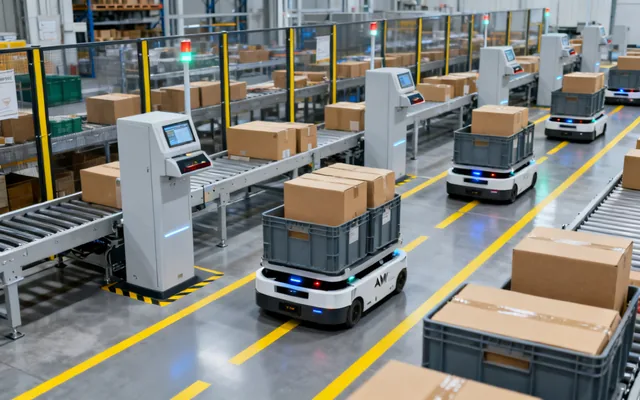
High SKU depth, promotion-driven peaks and ambient tote or carton moves require buffers that absorb returns and late waves without starving pack.
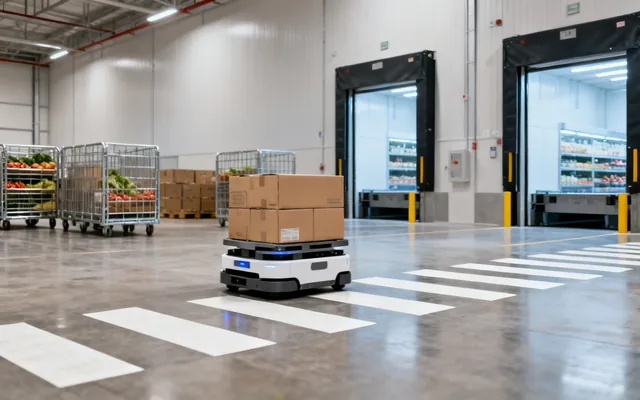
Cutoff waves, chilled door windows and mixed case or roll-cage loads force traffic rules that protect temperature dwell and dock turnaround.
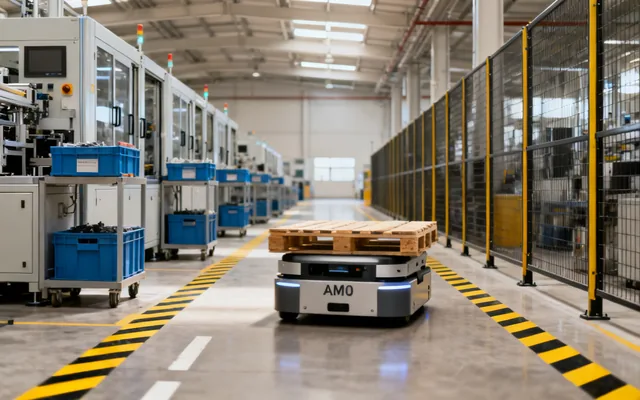
Takt-linked line feeding with pallets, racks and kits needs interface cycle times that keep PLC and WES ownership unambiguous during shift peaks.
A useful opening package is not a brochure request. It is a compact operating brief that lets engineering test whether AMR or AGV capacity can meet the stated peak without hiding recovery debt.
Include what the robot carries (kg and mm envelope), how often each route is demanded, which host layer owns the mission, where aisle width and floor joints constrain travel, and how a completed transaction will be accepted in FAT and SAT with a stated system availability boundary.