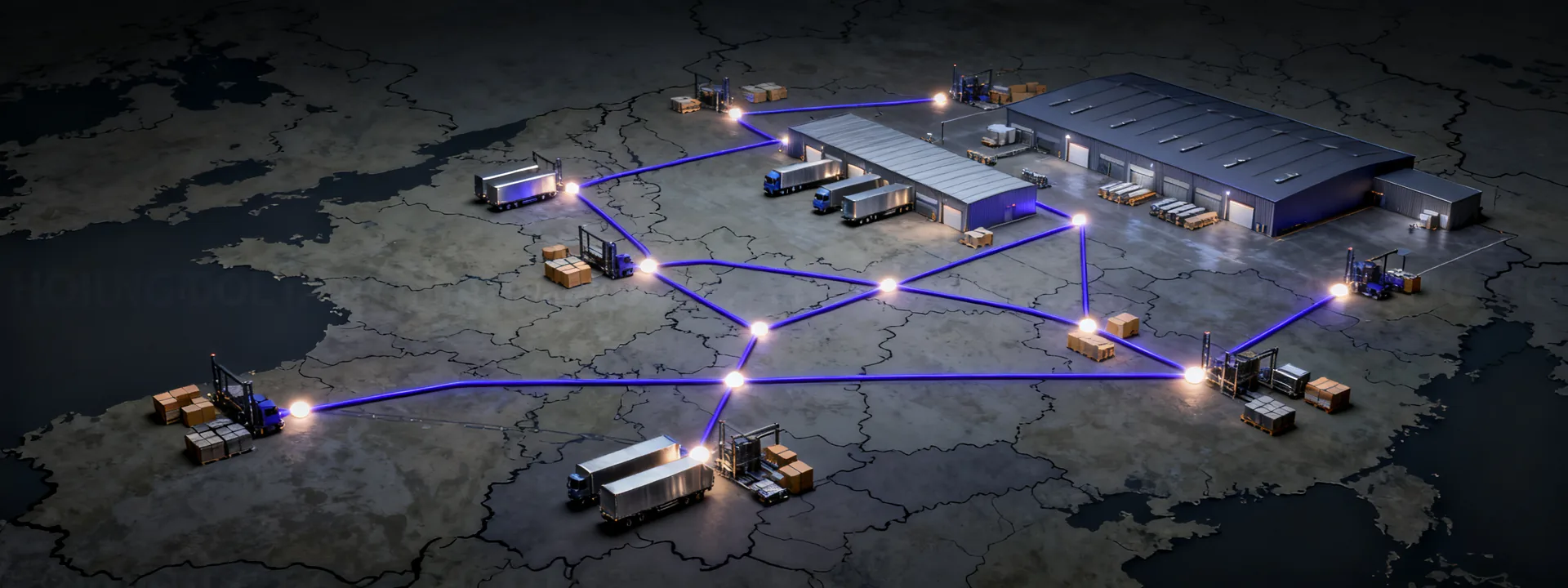
Vecna Robotics industries across regional warehouse operating profiles
Geography matters because peak calendars, labor models, temperature zones and host-system ecosystems differ. Use the tabs to compare how the same mobile-robot platform must be sized under different regional constraints.
Tab by region, then inspect the operating profile that drives fleet design
E-commerce and multi-client DCs
Promotion calendars and carrier cutoffs create overlapping peaks. Vecna Robotics projects in this region usually start by separating average tote moves from late-wave carton spikes, then mapping charging windows that do not collide with pack staging. Brownfield sites often keep forklift crossings active, so traffic priority and scanner fields must be validated with pedestrian and lift-truck interaction cases.
Manufacturing logistics corridors
Automotive and general manufacturing milk-runs emphasize interface cycle time. PLC and WES ownership for mission create, destination confirm and exception timeout must be written before fleet management system tuning. Floor joints and aisle width measurements frequently become the binding constraint rather than headline travel speed.
Grocery and ambient/chilled networks
Door-open time and temperature dwell dominate. Fleets must prove that route logic protects chilled zones without inventing density that blocks fire and maintenance access. Functional-safety documentation commonly references ISO 3691-4:2020 and ISO 13849-1:2015; treat those as design and validation scopes, not logo decoration.
Compact urban distribution
Shorter building footprints raise inventory cube utilization pressure. Selectivity versus dense storage trade-offs appear even when robots solely handle transport: sequencing and buffer occupancy become the real throughput governors when storage access is shared.
High-velocity parcel and retail replenishment
Order lines per hour claims must include merge logic, divert confirmation and exception recirculation. Vecna Robotics evaluations ask for timestamped extracts so peak factor is measured rather than guessed from a single holiday day.
Electronics and line-side kitting
Mixed pallet and tote families require adapter maps and center-of-gravity checks. SLAM navigation maps need maintenance when racking moves; change control for layout updates is part of the operating concept, not an afterthought.
Relative emphasis bars for discovery conversations
Bars are qualitative screening aids for discussion, not measured Vecna Robotics performance guarantees. Replace them with site data before commercial commitments.
Fixed automation versus flexible robotics
When order profiles are stable and divert accuracy dominates, fixed conveyors and sortation may outperform fleets on deterministic capacity. When SKU velocity and layout change often, flexible AMR fleets can reduce phased cutover risk. Vecna Robotics helps teams make that trade-off with shared data rather than slogan preference: state peak versus resilience priorities, then test both against the same recovery scenarios.
Centralized WCS versus modular orchestration
A centralized WCS/WES can optimize global buffer occupancy and merge logic, but concentrates failure impact. Modular controls with OPC UA or fieldbus boundaries can isolate a fleet management system fault from conveyor PLC logic, at the cost of more handshake timeouts to validate. Record interface cycle time in seconds for mission create, acknowledge and exception clear before choosing either architecture.
Density versus direct access
Raising inventory cube utilization can shrink travel, yet reduce selectivity and fire or maintenance access. If robots feed dense storage, document residual capacity at the load center, aisle width in mm and the manual recovery path when a shuttle or rack bay is blocked.
Ready to map your region and vertical constraints?
Send the operating profile, then use the form to request a structured review. Include temperature zones, peak calendars and host systems already in place.